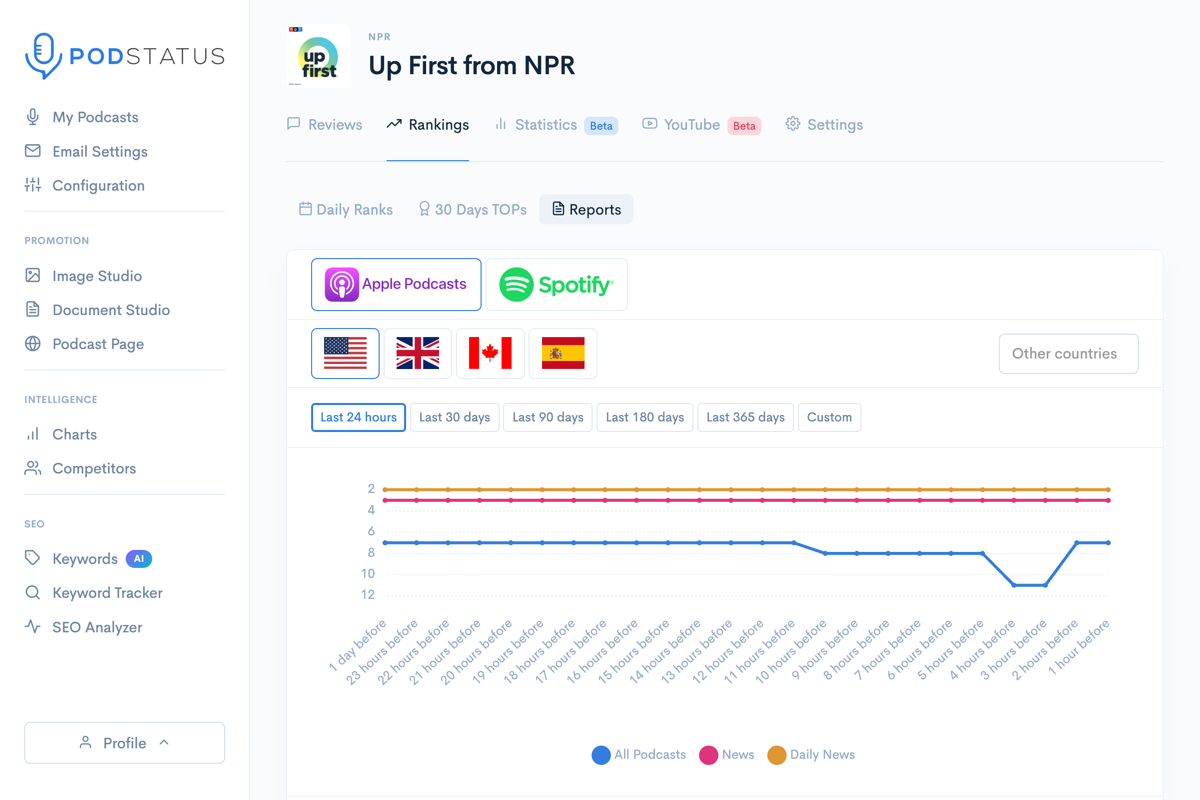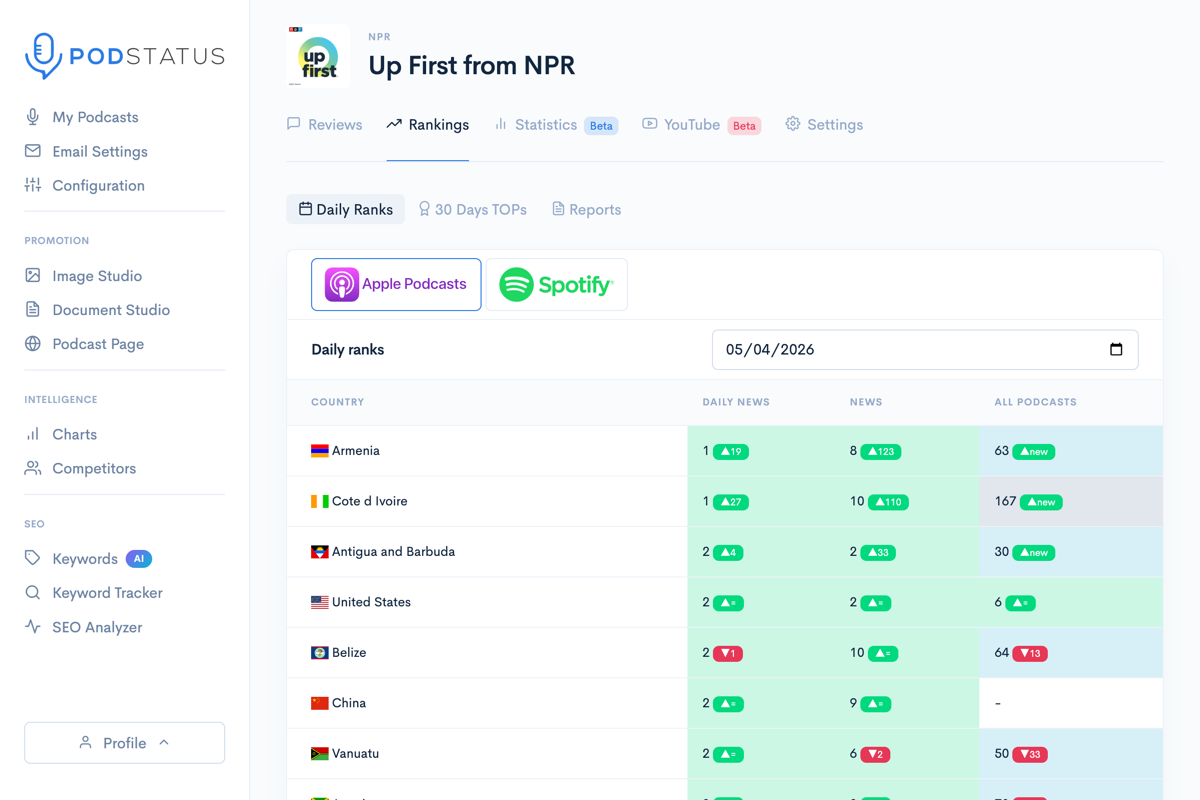
The first time your show appears on a podcast chart, taking a screenshot is the correct response. You worked for that moment. Save it, send it to the group chat, put it in the media kit.
Just do not mistake the screenshot for a complete performance report.
A chart position answers a narrow question: how is this show performing on this platform, in this market and category, at this point in time? That is valuable. It is also very different from “this is the 23rd biggest podcast in the world.”
Apple Podcasts and Spotify do not build their charts in the same way. Understanding the difference makes the numbers much more useful.
How Apple Podcasts charts work
Apple publishes charts by country or region and category. Its Top Shows and Trending Episodes lists are refreshed throughout the day, so a position can move quickly.
Apple does not publish the exact formula, but its own guide to Apple Podcasts Charts names three important signals:
- Listening: are people actively listening to episodes?
- Follows: are listeners choosing to follow the show?
- Completion: are they sticking with episodes rather than leaving early?
That combination matters. A sudden burst of follows with little listening is not the same signal as a group of people who find a show, follow it, and finish an episode.
Apple is equally clear about what the charts are not. They are not all-time listening records, automatic downloads do not count toward ranking, and positions cannot be bought.
Do Apple ratings and reviews affect chart position?
Not directly.
This is one of the most persistent pieces of podcast advice, probably because it sounds plausible. Apple says ratings, reviews, and shares are not part of the algorithm used for Top Shows or Trending Episodes. Apple also says they do not directly influence Search.
Reviews can still help a human decide to try your show. That listener may then play, follow, and finish an episode—behaviour that does matter. The distinction is important: reviews can improve trust, but they are not a secret chart lever.
How Spotify podcast charts work
Spotify describes three chart types in its podcast charts documentation:
- Top Podcasts: up to 200 shows in each available country, based on weekly unique audience.
- Trending Podcasts: shows gaining popularity, based on a mix of growth signals.
- Category charts: up to 50 shows within a category, in markets where Spotify offers category charts.
Spotify updates these charts daily. It also uses the first category in your RSS feed to decide which category chart your show may appear in.
That last detail catches people out. If a business podcast is appearing under Society & Culture, check the order of the categories in the RSS feed before assuming Spotify has made a random decision. Your hosting provider normally controls that field.
Why the two positions are not comparable
Imagine that a show is number 18 in Apple Podcasts Comedy in Canada and number 64 in Spotify Top Podcasts in Canada.
That does not mean the show is performing 3.5 times better on Apple. The lists cover different competitive sets and use different signals:
- Apple category charts compare the show with other podcasts in that category.
- Spotify's broad Top Podcasts list compares it with every eligible podcast in the market.
- Apple refreshes throughout the day; Spotify's chart is daily.
- Each platform has its own audience and listening behaviour.
Treat each chart as its own time series. Compare Apple Comedy Canada this week with Apple Comedy Canada last week. Compare Spotify Top Podcasts Canada with its previous Spotify positions. Cross-platform comparisons are useful for spotting broad patterns, not for calculating a universal rank.
Why podcast rankings move
Sometimes the cause is obvious. A well-known guest shares an episode, a clip takes off, or another podcast recommends the show. Often it is less dramatic.
Rankings can move because:
- more people found and listened to the show;
- existing listeners engaged more deeply;
- a campaign concentrated activity into a short period;
- the competing shows in that market had a stronger or weaker day;
- the show entered a different category;
- the platform refreshed its chart;
- a burst of interest happened in one country but not another.
The last point is easy to miss. Podcasts are global, but charts are local. A show may be invisible in its home market and quietly sitting at number 12 somewhere else.
What a chart position can tell you
A ranking is particularly useful for:
- spotting momentum after a release or campaign;
- discovering countries where the show has unexpected traction;
- comparing performance within a relevant category;
- capturing milestones for sponsors, guests, and your audience;
- deciding which markets deserve closer attention.
It becomes much more useful when you keep the context. Record the platform, country, category, position, date, and any campaign or episode that might explain the movement.
What it cannot tell you
A chart position alone cannot tell you:
- total downloads;
- the exact size of the audience;
- how many listeners became regulars;
- whether an ad campaign was profitable;
- whether one show has more lifetime listeners than another;
- why the position changed.
For those questions, pair rank with first-party platform analytics and download measurement. If you use a prefix such as OP3, compare verified download trends with chart movement. Look at follows, consumption or completion, and returning listeners where the platforms expose them.
A sensible chart-monitoring routine
You do not need a wall of screens. This is enough:
- Pick the two or three countries that matter most.
- Track the overall chart and one genuinely relevant category.
- Save the position at a consistent time or automate the collection.
- Note episode releases, guest promotions, paid campaigns, and press mentions.
- Review the trend weekly alongside listeners, downloads, follows, and completion.
The consistency matters more than checking every hour. Refreshing a chart manually all afternoon produces a lot of anxiety and not much analysis.
You can browse the current Apple Podcasts and Spotify charts for free. If you want the history, alerts, and international checks handled automatically, that is what Podstatus ranking tracking is built for.
How to improve your chances without gaming the chart
There is no ethical button marked “move me up 20 places.” The practical work is less exciting and more durable:
- Make the first few minutes strong enough that a new listener stays.
- Ask listeners to follow when the request fits naturally.
- Publish consistently enough that people know when to return.
- Choose accurate RSS categories, with the most important one first.
- Promote a specific episode to the audience most likely to enjoy it.
- Make it easy to continue listening after the first episode.
Avoid anyone selling guaranteed chart positions, synthetic follows, or download schemes. Even before a platform catches the manipulation, fake activity leaves you with numbers that cannot guide a real decision.
The useful way to think about rank
A podcast ranking is a smoke alarm, not a fire investigation. It tells you that something is happening. Your listener and download data help explain what.
Celebrate the chart appearance. Then save the context and look for the pattern.
If you are not sure where to begin, use this step-by-step guide to checking your podcast ranking.