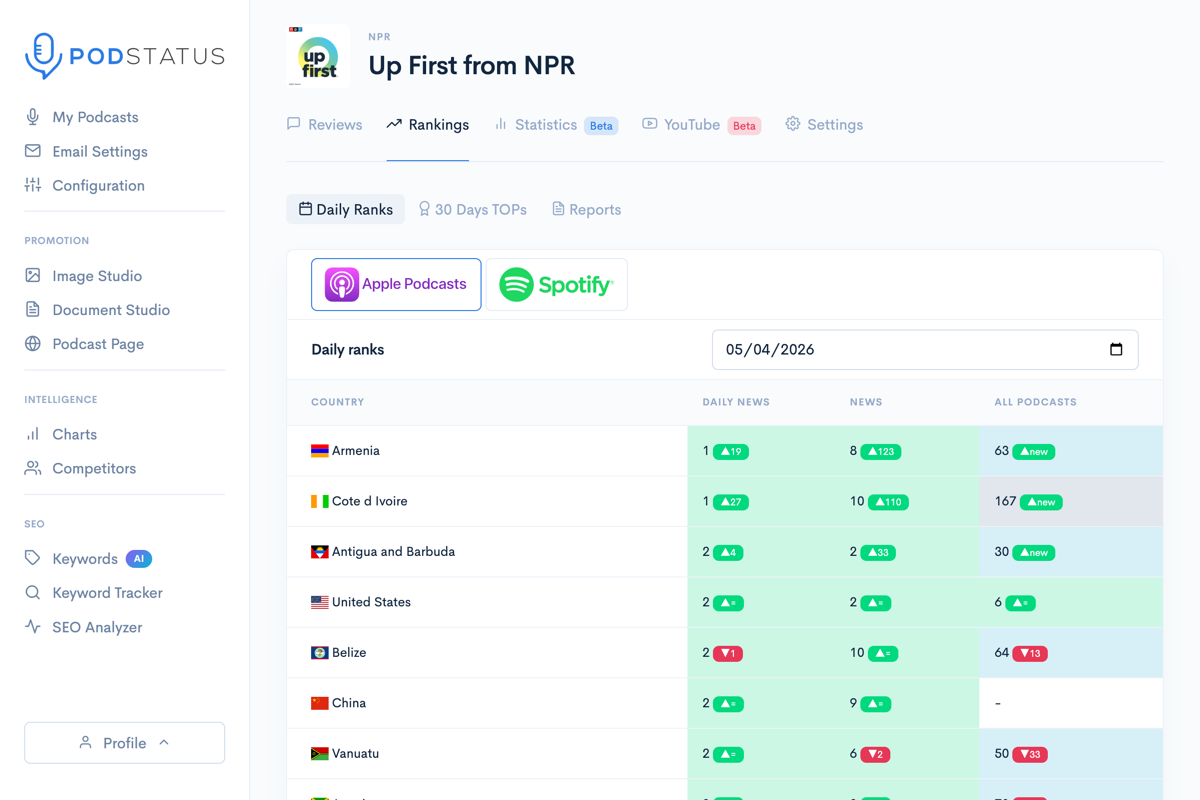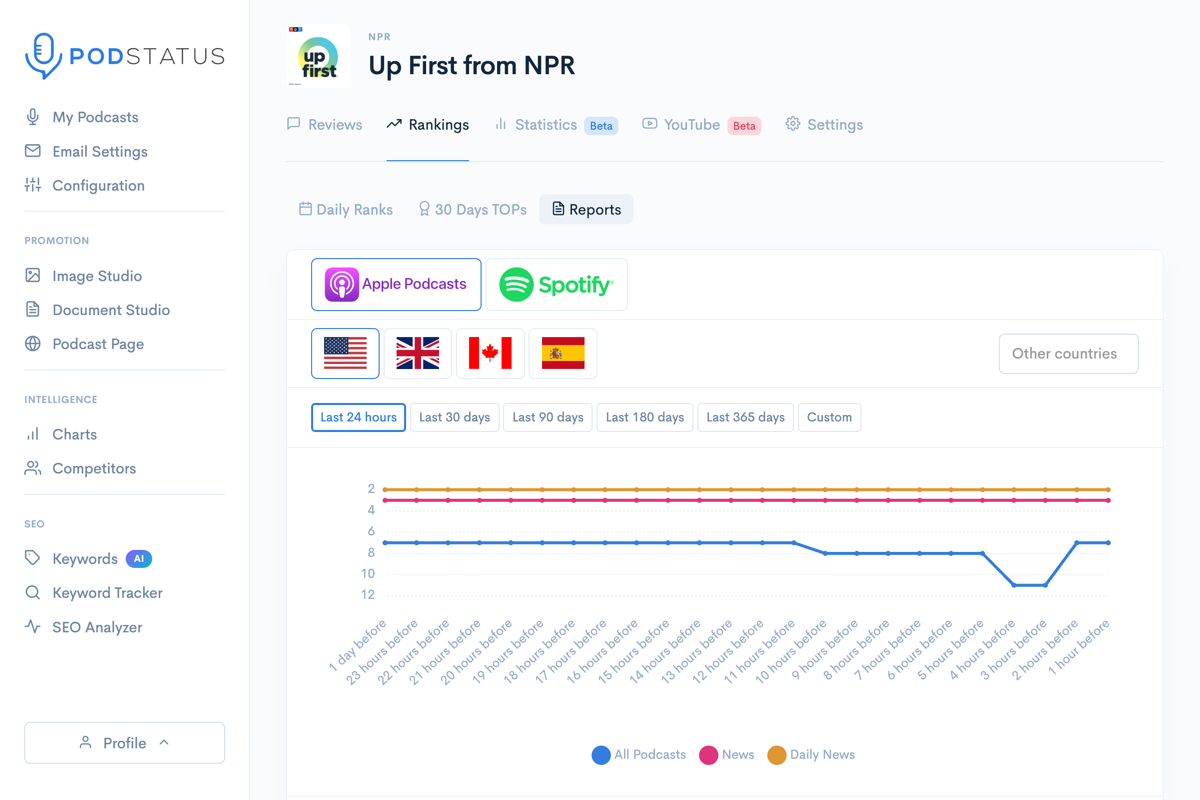
“Where does my podcast rank?” sounds like a one-number question.
It is usually a five-part question:
- On Apple Podcasts or Spotify?
- In which country?
- In the overall chart or a category?
- At what time?
- Do you want today's position or the history?
Skip those details and you can end up comparing two perfectly accurate numbers that describe different things.
Here is the quick way to check a rank, followed by the method I would use if the result needs to go into a sponsor deck or a growth review.
The fastest free check
Open the Podstatus podcast charts, choose Apple Podcasts or Spotify, select a country, and open either the overall chart or a category.
If the show appears, record:
- platform;
- country;
- category;
- position;
- date;
- episode or campaign that was active.
That is enough for a clean snapshot.
If the show is not there, it does not mean nobody is listening. Public charts have a fixed number of places, and the result is specific to one market and category. Try the most relevant category and the countries where your analytics show real listeners.
Checking an Apple Podcasts ranking
Apple organizes charts by market and category. A show can appear in the United States Comedy chart and not appear in the United Kingdom Comedy chart. It can also have different positions in All Podcasts and its category at the same moment.
To check:
- Open Apple Podcasts charts by country.
- Choose the country you care about.
- Open All Podcasts for the broad view.
- Open the show's primary category for a closer comparison.
- Search the page for the exact show title.
Apple refreshes its charts throughout the day. If you are monitoring manually, check at roughly the same time each day. Otherwise a morning position and an evening position may make a normal intraday change look like a major trend.
Which Apple category should you choose?
Use the category that actually describes the show and is present in its feed. Do not select a smaller category just because the competition looks easier.
Apple allows a primary and secondary category, including subcategories where available. The category settings affect where the show can appear, so they deserve a quick review when you launch or change the format.
Checking a Spotify podcast ranking
Spotify's Top Podcasts chart covers the broad market. Category charts are available in selected countries.
To check:
- Open Spotify podcast charts by country.
- Choose a country.
- Open Top Podcasts.
- If category charts are available, open the category that matches the show.
- Search for the exact title.
Spotify says its broad Top Podcasts chart is based on weekly unique audience and updates daily. That means you should not expect every hour of listening to create an immediate visible move.
Spotify uses the first category in the RSS feed when deciding which category chart a podcast can appear in. If the show is in the wrong category, fix the feed through the hosting provider rather than trying to correct it inside a chart tool.
Search the title, not the publisher
This sounds obvious until a network publishes 30 shows with similar branding.
Use the exact public show title. If the podcast has recently changed its name, check both the old and new title while directories refresh their metadata. Apple says RSS metadata updates can take up to 24 hours to appear.
For a common or one-word title, confirm the artwork and publisher before saving the position. Nobody wants to announce a chart milestone that belongs to a different show with the same name.
What if the podcast does not appear?
Work through these checks in order:
1. Confirm the show is available in that country
Distribution can differ by market. A podcast cannot rank where it is not available.
2. Confirm the category
Check the primary category in the RSS feed. A category mismatch is common after a format change or a hosting migration.
3. Check the overall chart
The show may be in the overall chart but not high enough in a category list—or the reverse.
4. Allow for the refresh cycle
Spotify is daily. Apple refreshes throughout the day. A campaign that started an hour ago may simply be too recent.
5. Accept that charts are selective
A healthy podcast can sit outside a public chart. Downloads, returning listeners, completion, and revenue may all be moving in the right direction without producing a visible ranking.
That is not a consolation prize. Those are often the better business metrics.
Save evidence a future you can understand
A screenshot without context becomes surprisingly useless after a few weeks.
Use a filename such as:
2026-07-24-apple-us-business-position-42.png
Add a short note:
Episode with Ana released Tuesday. Guest newsletter sent Wednesday. Position moved from 71 to 42 by Friday.
Now the chart position is attached to a plausible event. You still cannot claim that the newsletter caused the move, but you have a useful hypothesis to compare with listener and download data.
One check versus continuous tracking
A manual lookup is fine when:
- you are checking a milestone;
- a guest asks where the episode is charting;
- you only care about one country and category;
- you need a current screenshot.
Automatic tracking becomes worthwhile when:
- the audience spans several countries;
- positions change before you remember to check;
- you need history for a sponsor or client;
- a team wants alerts;
- you are comparing launches or campaigns;
- checking by hand has become a recurring task.
Podstatus checks rankings across Apple Podcasts, Spotify, and iVoox and keeps the history. The point is not to look at more charts. It is to stop rebuilding the same record every week.
The five-minute weekly ranking review
If charts matter to your show, put this on the calendar once a week:
- Review the primary country and category.
- Note the best, worst, and current position.
- Mark episode releases and promotion dates.
- Compare rank with downloads, listeners, follows, and completion.
- Decide whether anything actually needs a response.
Most weeks, the decision may be “keep going.” That is still a decision.
Avoid changing titles, categories, or publishing plans in reaction to one daily move. Look for repeated patterns: the same type of guest lifting several markets, a category that consistently performs better, or a country that is growing faster than expected.
Report the position accurately
For a sponsor deck, write:
Reached #12 in Apple Podcasts Business in Spain on July 24, 2026.
Do not write:
The 12th biggest business podcast.
The first statement is precise and verifiable. The second quietly drops the platform, market, date, and chart definition.
That precision makes the achievement more credible, not less.
Start with the current chart
Use the free Apple Podcasts and Spotify chart browser for today's position. If you need history and alerts instead of another spreadsheet, see the Podstatus ranking tracker.
And before drawing conclusions from a move, read how Apple Podcasts and Spotify charts actually work.