There is no magic “podcast keywords” field where you paste 50 phrases and wait for Apple Podcasts or Spotify to deliver an audience.
That is good news.
It means podcast search optimisation is mostly understandable work: learn how listeners describe the subject, make the show's metadata clear, and publish episodes that genuinely answer those searches.
The hard part is choosing language that is specific enough to be useful without turning every title into a list of keywords.
What a podcast keyword really is
A keyword is a phrase a listener might use when looking for a show or episode.
It can describe:
- a topic:
freelance design; - a problem:
how to price consulting; - an audience:
parenting podcast for dads; - a format:
short history stories; - a person:
interview with Jane Goodall; - an event:
Tour de France analysis; - a place or language:
podcast de tecnología en español.
The best keyword is not always the phrase with the largest theoretical audience. It is the phrase where your show is a strong answer.
A podcast about accounting for independent photographers will probably attract fewer searches than “business podcast.” It will also be far more relevant to the right listener.
How Apple Podcasts Search works
Apple's current Search documentation identifies several factors:
- metadata, including show name, channel name, and episode title;
- popularity, such as followers and plays;
- behaviour after a search, including plays and follows.
Apple also recommends specific, distinctive show and episode titles. Ratings and reviews are not direct Search inputs.
This creates a useful rule: metadata helps a show become eligible and understandable; listener response helps prove that the result was useful.
Repeating a term 12 times may make the metadata clearer to nobody. A specific title that earns a play and a follow is the better outcome.
Start with the listener's sentence
Before opening a keyword tool, write the sentence a real listener might say:
I want a podcast that helps me negotiate a salary in tech.
That sentence contains several possible searches:
- salary negotiation;
- negotiate tech salary;
- software engineer compensation;
- asking for a raise in tech;
- job offer negotiation.
Now compare those with the show. Which phrases match episodes you already have or can credibly make?
Do not begin with a giant list. Begin with five to ten topics where the show has experience, evidence, or a distinctive point of view.
Five places to find useful podcast search language
1. Your own audience
Read emails, comments, reviews, community posts, and survey answers. Listeners often describe the value more plainly than the show's official copy.
A host may say:
Long-form conversations about modern independent work.
Listeners may say:
It helps me price freelance projects.
The second sentence is probably closer to a search.
2. Search suggestions
Type the core topic into Apple Podcasts, Spotify, YouTube, and Google. Note the suggestions that are genuinely relevant.
Suggestions are prompts, not instructions. You still need to decide whether the phrase matches the show and whether the existing results reveal an unmet need.
3. Competing and adjacent shows
Look at the language used by podcasts serving the same audience:
- Which topics repeat?
- Which episode titles are specific?
- Which useful questions are being ignored?
- Where is everybody using the same vague wording?
Do not copy titles or descriptions. The goal is to understand the market vocabulary and find the part only your show can own.
4. Your back catalogue
The episodes with strong search, completion, or long-tail downloads are evidence.
Group them by topic. If several episodes about contract negotiation keep attracting listeners months later, that cluster deserves more attention than a trend that produced one short spike.
5. Customer or client conversations
For a branded podcast, sales calls and support tickets are full of precise questions. Remove confidential details and look for recurring wording.
An episode titled “The Future of Operations” is vague. “How to Cut Warehouse Picking Errors” answers a question somebody is already asking.
Build a small keyword map
Use three levels:
Show-level themes
Choose three to five broad themes that describe the entire podcast.
For a show about independent creative businesses:
- freelance pricing;
- creative business;
- client management;
- contracts;
- sustainable self-employment.
These themes belong naturally in the show description and editorial plan.
Topic clusters
Break each theme into specific recurring questions.
Freelance pricing might include:
- hourly rate vs project fee;
- raising rates;
- pricing retainers;
- handling scope creep;
- estimating a design project.
Clusters help a listener—and a platform—understand that one successful episode was not an accident.
Episode-level phrases
Pick one primary question or phrase for each episode. Add closely related language only where it reads naturally.
An episode can cover several ideas, but its title should make one promise.
Write a show title for people who have never heard of you
Distinctive names are memorable. Generic names are understandable. Good podcast branding often needs both.
If the brand name is abstract, use the description and subtitle fields available through the hosting platform to clarify the subject. Do not stuff the official title with a chain of search phrases:
Bright Work | Freelancing, Creative Business, Pricing, Clients, Marketing, Design, Money
That is not a title. It is a cupboard where every keyword has been pushed before visitors arrive.
Keep the show name recognisable. Make the first lines of the description do the explanatory work.
Write a show description that earns the click
The opening should answer:
- Who is this for?
- What will they learn or feel?
- What makes this show different?
- What format and publishing rhythm should they expect?
Apple's guidance on presenting a podcast recommends using vocabulary your audience would search for while keeping the copy focused on the listener's benefit.
An example:
Bright Work is a weekly podcast for independent designers who want to price projects confidently, manage clients without chaos, and build a creative business that leaves room for a life.
The useful phrases are present because they explain the show. They do not feel bolted on.
Episode titles carry the search intent
Compare:
Episode 84: A Conversation with Maya
with:
How to Raise Your Freelance Rates with Maya Chen
The second title tells an unfamiliar listener why to care. The guest still gets credit, but the topic leads.
Useful patterns include:
- How to [achieve outcome]
- Why [common approach] fails
- [Number] mistakes in [specific task]
- [Guest]: [specific subject]
- What [event or change] means for [audience]
Patterns are scaffolding, not a requirement. If every title uses the same template, the feed starts to sound manufactured.
Avoid adding the show name, date, and episode number to the visible title when the platform already displays that information. Apple explicitly recommends using the title space for the important part of the episode.
Categories are not keywords, but they matter
Choose the most accurate primary category and a useful secondary category where supported.
Apple says the primary category affects category pages, charts, and recommendations, while a relevant secondary category can improve coverage in other discovery surfaces. Spotify uses the first RSS category for its category charts.
Do not choose an unrelated small category to chase an easier chart. The wrong context may create impressions from people who never wanted the show, which is not useful discovery.
Avoid these podcast SEO habits
Keyword stuffing
Repeating a phrase in the title, author field, and every sentence makes the listing harder to trust. Apple prohibits attempts to manipulate Search with inaccurate or inappropriate metadata.
Copying a larger show's name
It creates confusion, weakens the brand, and can cross into impersonation.
Writing for a trend you cannot serve
One unrelated celebrity episode may attract a few searches and no returning listeners. Reach without fit is a poor trade.
Renaming the show every month
Directories need time to refresh, listeners lose recognition, and historical links become harder to understand. Change the name when the positioning has genuinely changed, not because one phrase looked attractive.
Promising an answer the episode does not contain
A click that turns into an immediate exit is not a win.
Measure podcast search visibility
Keep the process simple:
- Select a small set of relevant phrases.
- Record the current position or whether the show appears.
- Improve the metadata and publish genuinely related episodes.
- Allow directories time to refresh.
- Review position, impressions where available, plays from search, follows, and consumption.
- Keep, revise, or drop the phrase based on listener response.
Rank is only the first step. A phrase that produces impressions but no listening may be too broad or poorly matched. A lower-volume phrase that brings engaged followers can be far more valuable.
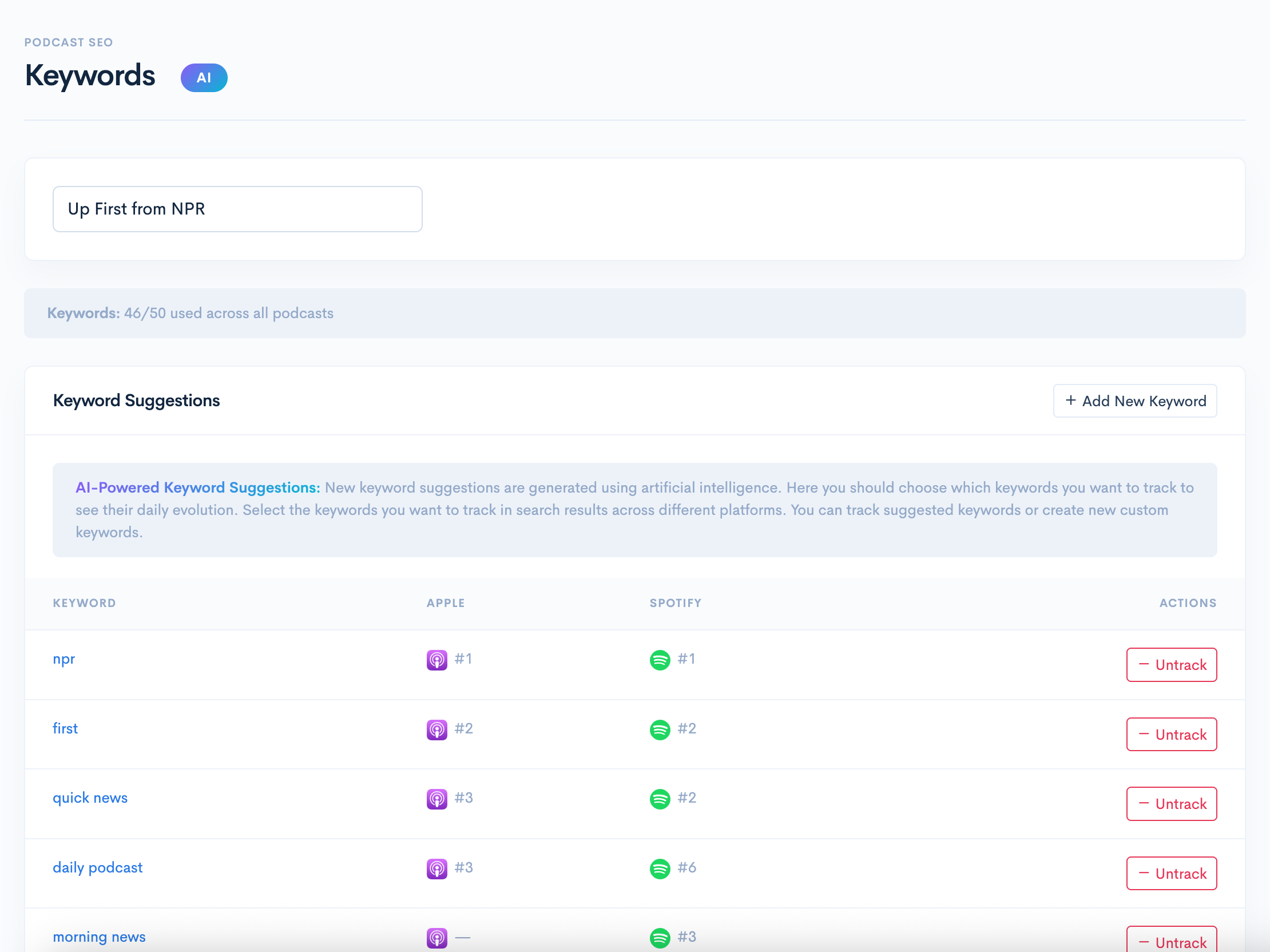
Podstatus includes podcast keyword tracking and an SEO analyzer so you can monitor the terms and inspect the metadata without rebuilding the checks by hand.
A 30-minute keyword routine
Once a month:
- review the search phrases bringing real listeners;
- collect five audience questions from emails, reviews, or communities;
- identify two back-catalogue episodes that deserve clearer titles or descriptions;
- choose one topic cluster for the next release;
- check whether the show categories still match the format;
- remove keywords that attract the wrong audience.
Do not rewrite the whole catalogue in one afternoon. Make a small number of defensible changes and watch what happens.
Clarity is the durable SEO advantage
Podcast search is not a contest to mention the most phrases. It is a matching problem.
Say clearly who the show is for. Give every episode a specific promise. Use the language listeners already use. Then make sure the episode keeps that promise when they press play.
That is good metadata, good marketing, and—conveniently—good podcasting.