There is something slightly maddening about publishing an episode, doing the promo work, and then having to guess whether any of it moved the charts. Maybe you are climbing. Maybe you peaked for three hours in a country you never thought to check. Maybe nothing happened at all.
A ranking tracker should answer those questions for you, but the details matter more than most people expect. Some tools check once a day. Some only cover Apple Podcasts. Some show today's position but never save enough history to tell you if anything is improving.
So before you pick one, it helps to know what separates a proper tracker from a simple chart lookup.
Disclosure: Podstatus publishes this guide and is one of the tools compared. Product details and prices were reviewed on July 29, 2026. Podkite did not expose current plan content in machine-readable public HTML, so its details remain unverified; confirm all time-sensitive claims with each vendor.
What actually matters in a ranking tracker
Before getting into the tools, these are the four things that make the biggest difference in practice:
Platform coverage. Apple Podcasts is not the only game in town. Spotify is huge and growing. iVoox dominates Spanish-speaking markets. If your tracker only checks Apple, you are seeing a third of the picture.
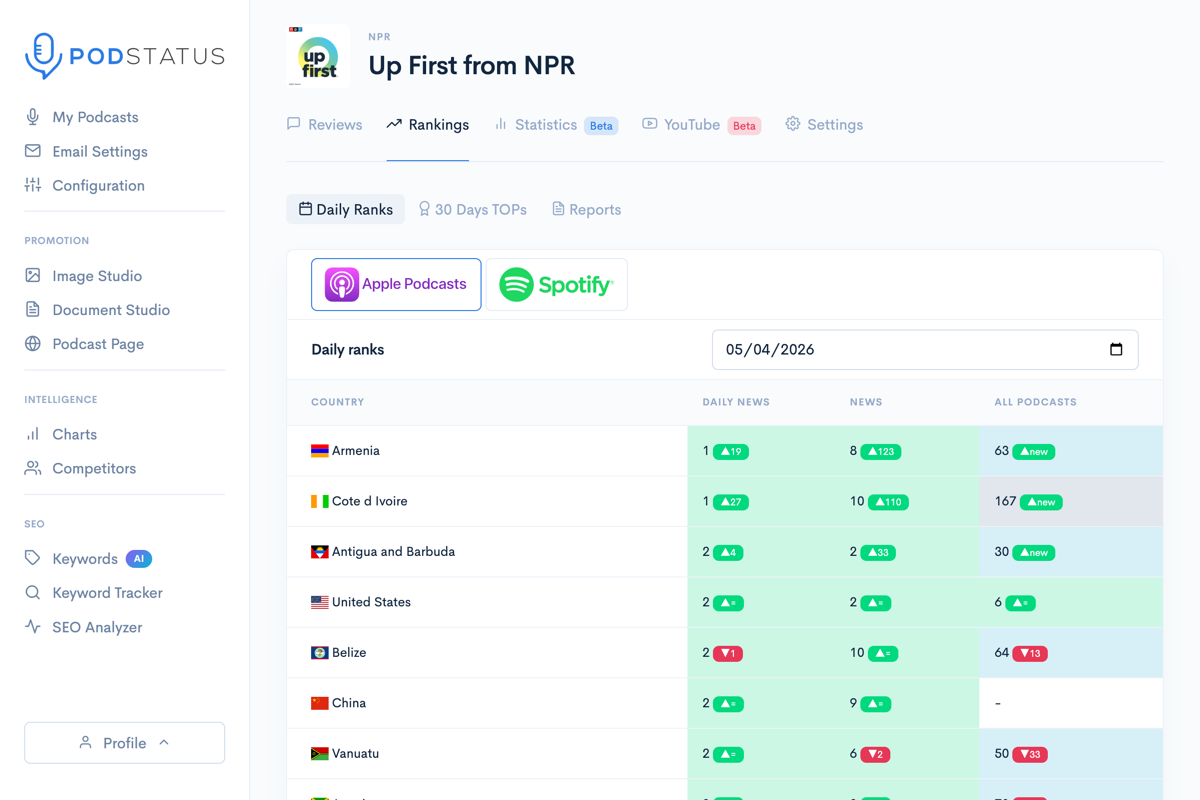
Country coverage. Charts exist in 175+ countries. Your show can be quietly gaining traction in Germany, Mexico, or Japan and you will never notice if your tracker only watches a small slice of the map.
Update frequency. This is the underrated one. A daily check tells you where you finished. An hourly check shows you the spike that happened right after a guest shared the episode or a newsletter went out. That spike often disappears before the next day's snapshot.
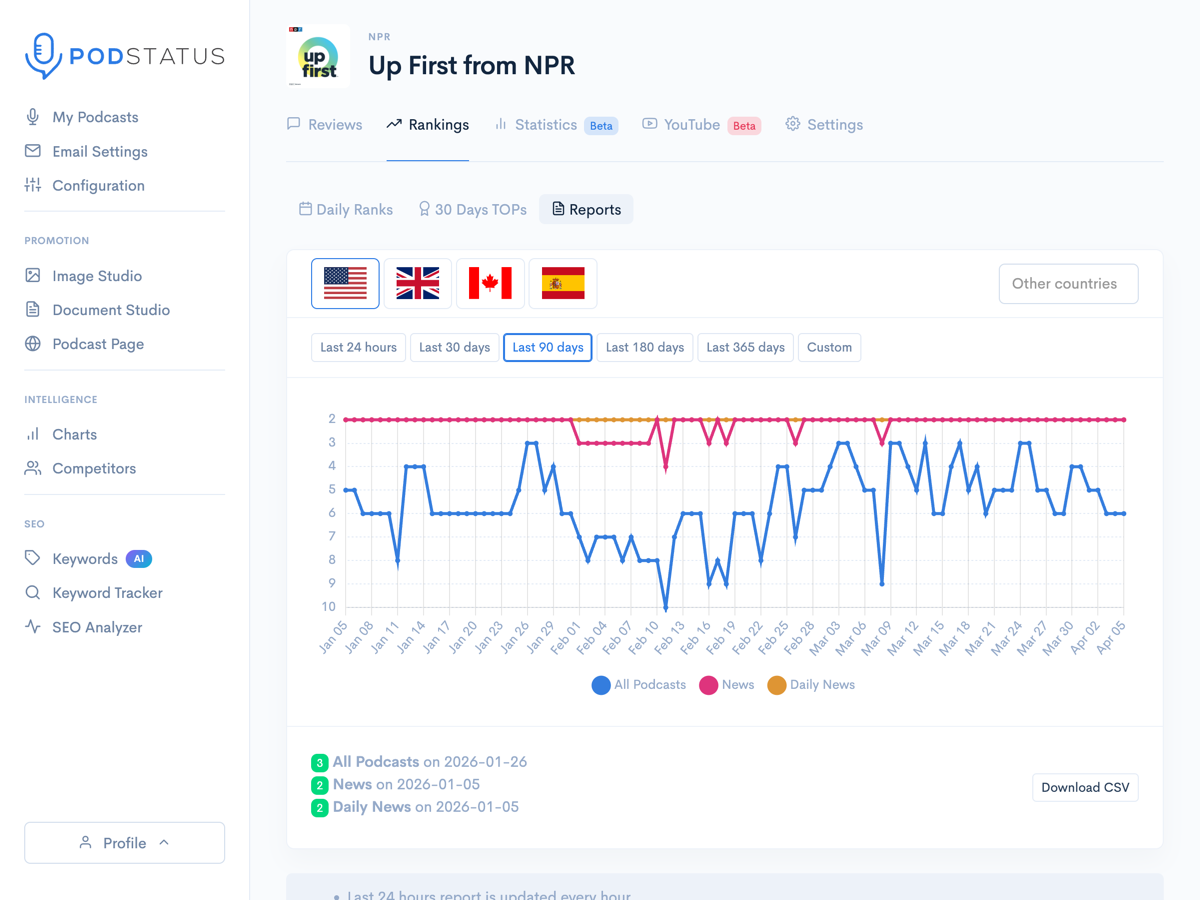
Historical data. Today's ranking is interesting for about five minutes. The trend across weeks or months is what actually helps you learn something.
The options, compared honestly
Podstatus
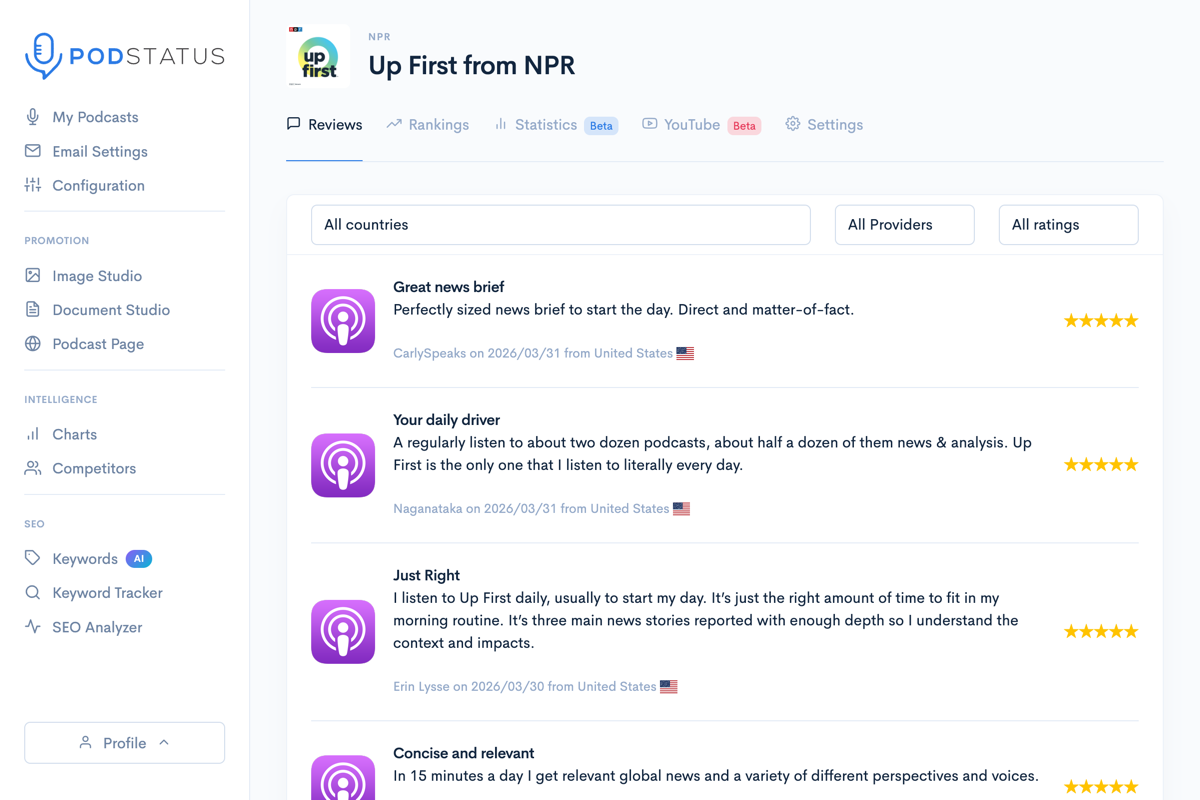
Tracks Apple Podcasts, Spotify, and iVoox across 175 countries with hourly updates. It stores chart history from the moment you sign up, and it also pulls reviews, keyword tracking, SEO analysis, and competitor monitoring into the same dashboard.
$7.99 month-to-month or $59.99/year for 5 podcasts (a rounded $5/month annual equivalent). 7-day free trial.
This is our product, so take that into account. The pitch is basically that chart tracking makes more sense when it is connected to the rest of your visibility data. If you want the side-by-side detail: Podstatus vs Podgagement, Podstatus vs Podkite.
Podgagement
Podgagement publishes Apple Podcasts and Spotify ranking and search tracking with hourly chart detail across nearly 34,000 charts. Its distinctive layer is engagement: listener feedback, NFC beacons, images, landing pages, and Slack notifications.
$9-19/month per selected podcast. The per-podcast pricing is the big trade-off: three shows at the $9 entry level cost $27/month.
It makes the most sense if listener interaction and promotional tools matter alongside charts. Podstatus instead adds iVoox, OP3, account-level pricing, and a separate RSS/metadata SEO workflow.
Podkite
Podkite's public site identifies the product with podcast charts, reviews, and podcast links. Its pages did not expose current plan, platform, country, or refresh-rate details in machine-readable public HTML when checked July 29, 2026.
Current pricing and limits were not independently confirmed.
Historical descriptions mentioned a free tier, SmartLinks, and long-running history, but those should not be treated as current facts without confirmation from Podkite.
Free chart browsers (Ausha Charts, mowPod)
These let you search current charts, see a ranking, and move on. Helpful for a quick check, but they are browsers rather than trackers.
Free, no signup.
Useful for a one-off "am I charting?" moment. Not very useful if you want to monitor progress over time, because every answer depends on you remembering to go look.
Adjacent tools that are not the same kind of tracker
Podrover is review-focused and does not publish podcast-app chart tracking. Podtrac publishes industry rankings based on measured audience, not continuous Apple Podcasts or Spotify app-chart positions. Rephonic includes chart and related-show data for research, but its core workflow is B2B discovery and outreach rather than monitoring an owned show's app positions. These can be useful products without replacing a dedicated chart tracker.
The hourly vs. daily debate
This deserves its own section because it sounds like a small detail until you have lived with both.
Charts move throughout the day. When a new episode hits or a guest drives traffic, your podcast might jump into the top 10 of a category for a few hours and then settle back down. If your tracker only checks once a day, that moment never shows up in your history.
That matters because those short-lived spikes are often the clearest signal you get. They tell you which episodes hit, which promo pushes worked, and which appearances were worth the effort. If all you ever see is the end-of-day position, you miss the part that is actually useful.
Podstatus and Podgagement both publish hourly monitoring. Compare them on platform scope, pricing model, stored history, reporting, and whether you need Podgagement's engagement tools or Podstatus's iVoox, OP3, metadata, and account-level workflow. Free chart browsers provide a current lookup rather than automated history.
My recommendation
If you are casually curious and do not want to spend anything, use a current chart browser such as Ausha Charts. Verify Podkite directly before relying on historical free-plan claims.
If you actually want to learn from your chart data, you need multiple platforms, decent country coverage, stored history, and updates frequent enough to catch movement while it is happening. That is where Podstatus is strongest.
The real difference is simple: one setup leaves you with hunches, the other leaves you with evidence.