Free tools are appealing for an obvious reason: when a show is small, every extra subscription feels unnecessary. And to be fair, there are some genuinely useful free podcast tools out there.
The problem is that each free tool tends to answer one narrow question. You can check a chart, or count downloads, or get a certified measurement number, but you rarely get a joined-up view of what is happening. That is the trade-off this post is really about.
Ausha Charts
Ausha Charts is a free chart browser. You pick a country and category, search for your show, and see the current Apple Podcasts or Spotify chart position.
And that is pretty much all it does.
What you do not get is the part that becomes useful later: no tracking over time, no alerts, no historical data, and no easy way to compare this week with last week. Every check starts from scratch.
It is useful for a quick "am I charting?" moment. If you are trying to understand trends, campaign impact, or slow growth in a particular country, it runs out of road quickly.
mowPod Charts
Very similar to Ausha Charts, but focused on Apple Podcasts. You browse current charts, see the position, and that is basically the whole interaction.
If you only care about Apple Podcasts and want a quick lookup once in a while, it works fine. But it is still a lookup tool, not a tracking system.
OP3 (Open Podcast Prefix Project)
OP3 is different from the chart browsers. It is an open-source project for podcast download tracking. You add a prefix to your RSS feed, and OP3 counts downloads in a transparent, privacy-respecting way.
It is genuinely good at what it is meant to do. If transparent download measurement matters to you, OP3 is easy to like.
What it does not do is connect downloads to discoverability. It will not tell you where you rank, what people are searching for, or whether your reviews and chart movement are improving alongside those downloads.
Worth mentioning: Podstatus integrates directly with OP3, so if you use Podstatus, you get OP3 download data alongside all your other analytics in one place.
Podtrac (free tier)
Podtrac publishes IAB-certified podcast measurement, and its basic tier is free. That makes it relevant when sponsors or networks require certified numbers.
The free plan is primarily a measurement product. Podtrac's paid plans broaden the workflow with features such as demographics, Smart Links, promo trades, attribution, and advanced reporting. Across the range, it does not publish the same ongoing app-chart, review, podcast-search, SEO, or chart-proximity workflow as Podstatus.
You get credible measurement and can add campaign tools, but native-app discoverability still needs a different data source.
The pattern you have probably noticed
This is the pattern:
- Ausha Charts: browse charts
- mowPod: browse Apple charts
- OP3: count downloads
- Podtrac free: certified download and audience measurement
None of them really combine those answers. They give you fragments, not a full story.
That is not really a criticism. Free products have to draw the line somewhere. It just means that if you rely on them alone, you will spend a lot of time stitching partial answers together.
What the gaps actually cost you
Here is what that usually means in practice:
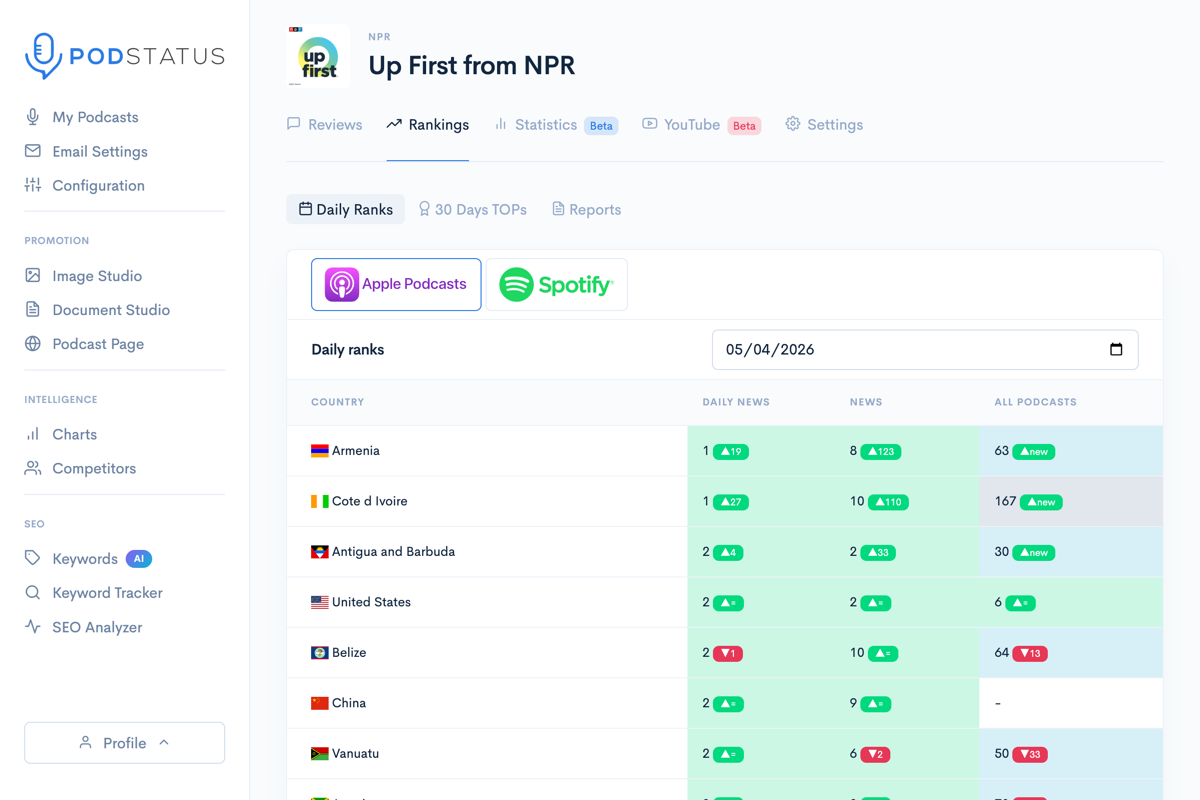
You miss international audiences. Your podcast might be charting in markets you would never think to check manually, and by the time you do, the moment may be gone.
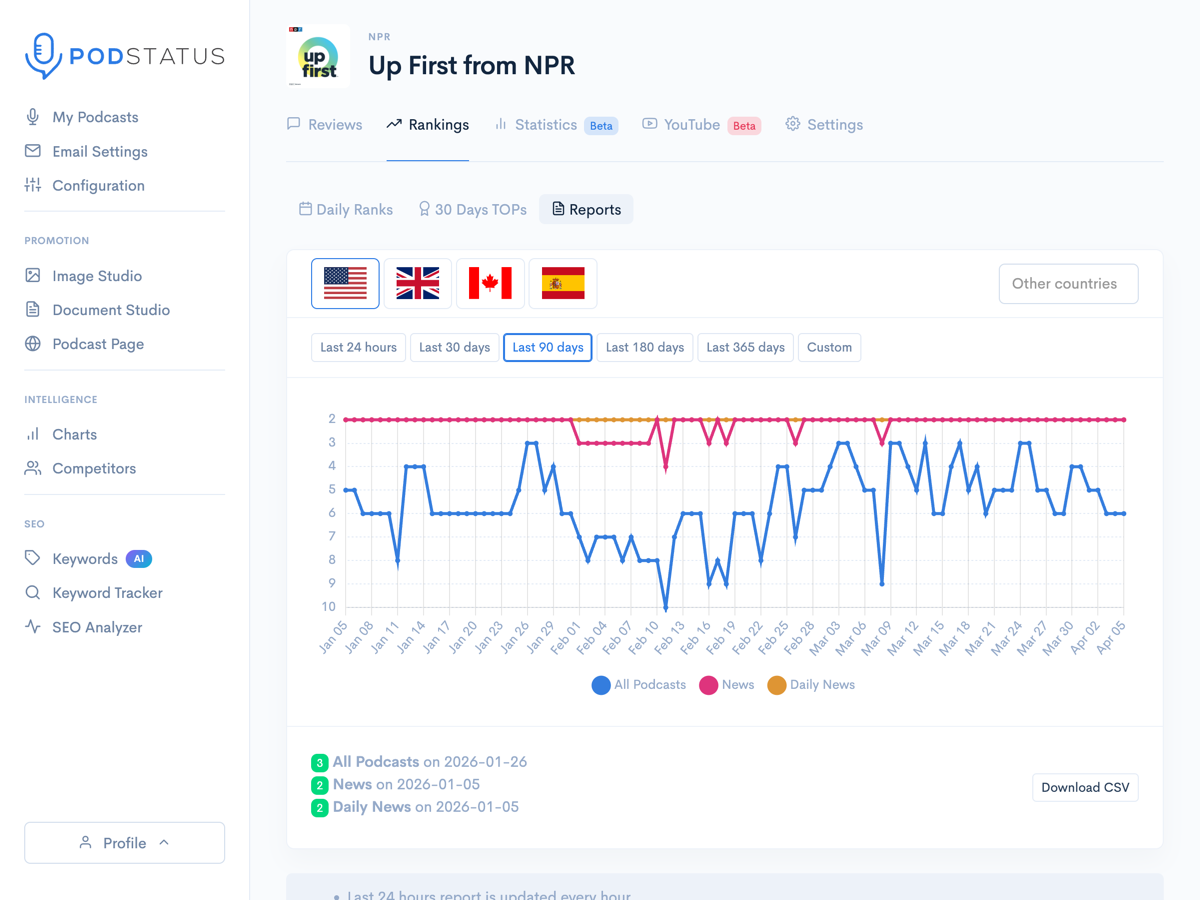
You miss trends. A snapshot tells you where you are now, not whether the show is moving in the right direction.
You miss keyword opportunities. Without search visibility data, it is hard to tell whether people are finding you by title, topic, guest, or not finding you at all.
You miss competitive context. Similar shows may be climbing because they rank for terms you do not, or because they are strong in countries you have ignored. Free tools rarely show that.
You spend more time checking than learning. Manual lookups feel harmless until you realise you are rebuilding the same picture over and over again.
When a $5/month annual equivalent makes sense
I am obviously biased here, so take the recommendation with that in mind. Still, the reason a low-cost paid tool can make sense is pretty simple:
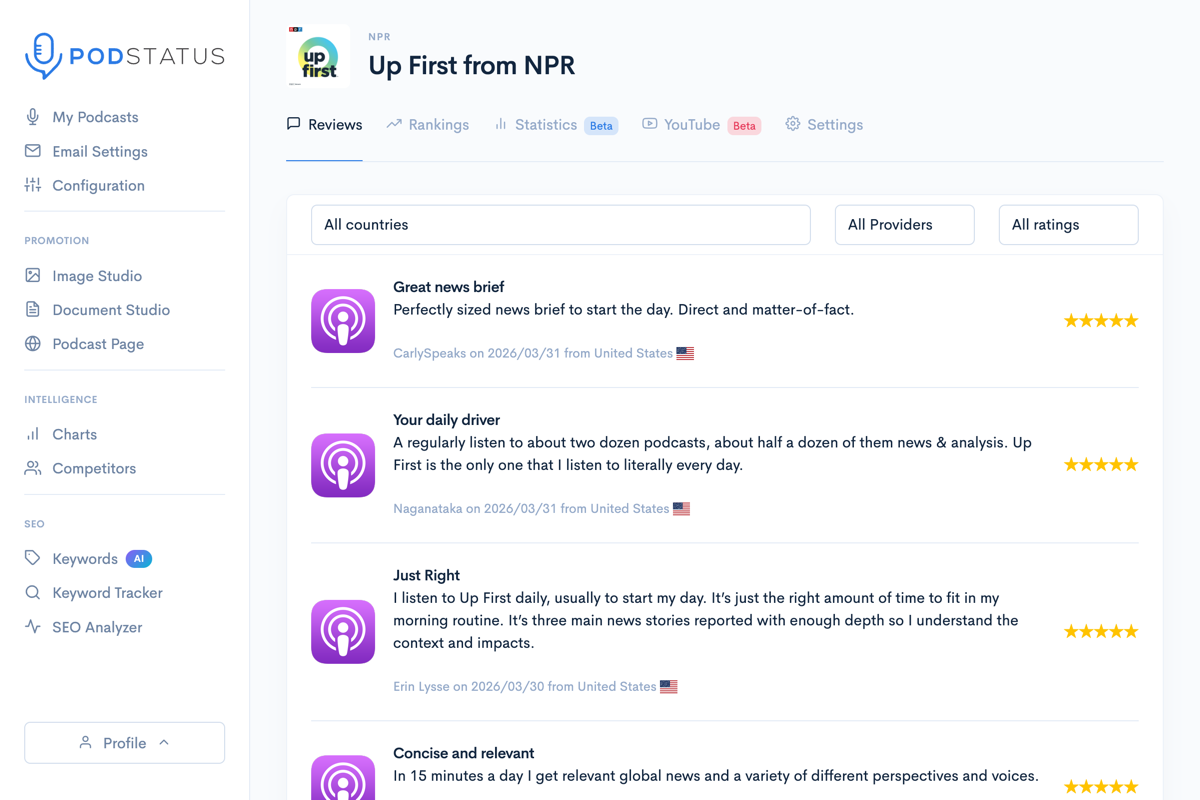
Podstatus Solo costs $7.99 month-to-month or $59.99/year, a rounded $5/month annual equivalent. It includes hourly chart checks across 175 countries on Apple Podcasts, Spotify, and iVoox, review monitoring, competitor intelligence, OP3 data views, Image Studio, and email reports for up to 5 podcasts.
Keyword tracking, the SEO Analyzer, YouTube analytics, and PDF documents are Professional features. Professional costs $14.99 month-to-month or $119.99/year, a rounded $10/month annual equivalent, for up to 12 podcasts.
It gives you the chart tracking, review monitoring, search visibility, competitive context, and download data in one place instead of making you bounce between tools.
If you are serious about growing the show, the time savings alone can justify that price. The bigger value is that you stop making decisions from disconnected snapshots.
If you are just starting out, free tools are still useful. They are a perfectly reasonable way to test the waters. The important thing is not to confuse "I can look something up" with "I have a system for tracking performance."
If you want to see how each free tool compares to what you get with a paid option, we have detailed comparisons for Podtrac and the other tools in our analytics tools comparison.